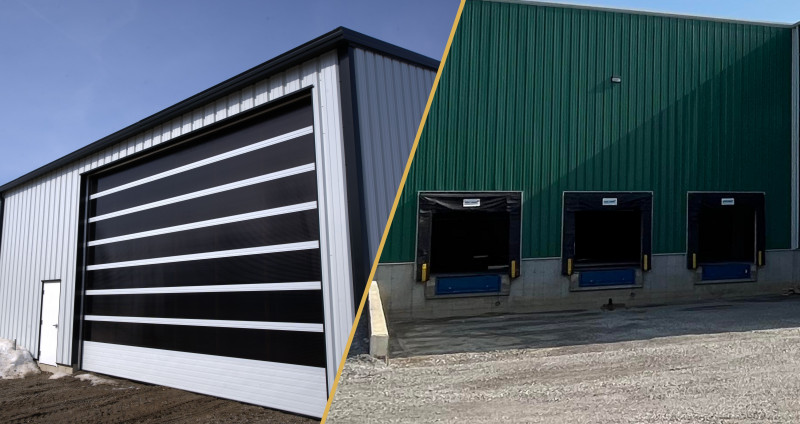
Overhead Doors vs. Dock Doors in Ontario Pre-Engineered Metal Buildings
Choosing the right door system is an essential part of designing a pre-engineered metal building (PEMB), especially in Ontario where climate and code requirements add extra considerations. Although dock doors and overhead doors may look similar, they serve different purposes and must be integrated differently into a metal building structure.
Overhead Doors
Overhead doors are commonly used in shops, garages, farm buildings, and service bays, and can vary greatly in size, accommodating tall skinny openings or short and wide openings. These doors operate on interior tracks and require clear headroom and backroom inside the PEMB. There is also a variety of door mechanics that can be used depending on the use of the building and how it is designed, for example, quick lift, vertical lift, and rolling doors all attach slightly differently to the building. They are ideal where the floor is at grade and where general vehicle or equipment access is the priority. Overhead doors are cost-effective, versatile, and easier to integrate into standard PEMB framing.
Dock Doors
Dock doors, however, are designed for shipping and receiving. They work in conjunction with raised loading docks, pit levelers, truck restraints, bumpers, and dock seals or shelters. Because transport trucks back directly into the opening, dock doors require reinforced jambs, curb walls, and tighter air sealing, especially in heated or conditioned buildings. Dock doors are more standard in sizing, eg. 8’ x 8’ or 8’ x 10’ because trucks are mostly standard size. These doors are also installed at tailgate height, meaning the site is usually graded to have sloped back up pits for the truck.
Specific Considerations for Ontario
In Ontario, the choice between these doors includes several additional factors:
- High Ontario snow loads require stronger door framing, heavier headers, and stricter deflection limits to prevent door binding.
- SB-10 energy requirements may necessitate insulated overhead doors or dock systems with superior air seals in climate-controlled buildings.
- Frost depth (of approx. 1.2m in OBC) affects dock pit and leveler design.
- Lot-line and fire-separation rules can restrict where dock or overhead doors may be located.
- Ontario’s freeze-thaw cycles demand higher-quality gaskets, seals, and door hardware.
It is also important to consider the logistical needs of the tenant, now and in the future, as overhead doors are an easier integration than a dock door. Choosing the right door type, and designing it correctly for Ontario conditions, ensures performance, durability, energy efficiency, and smooth operation throughout the life of the building.